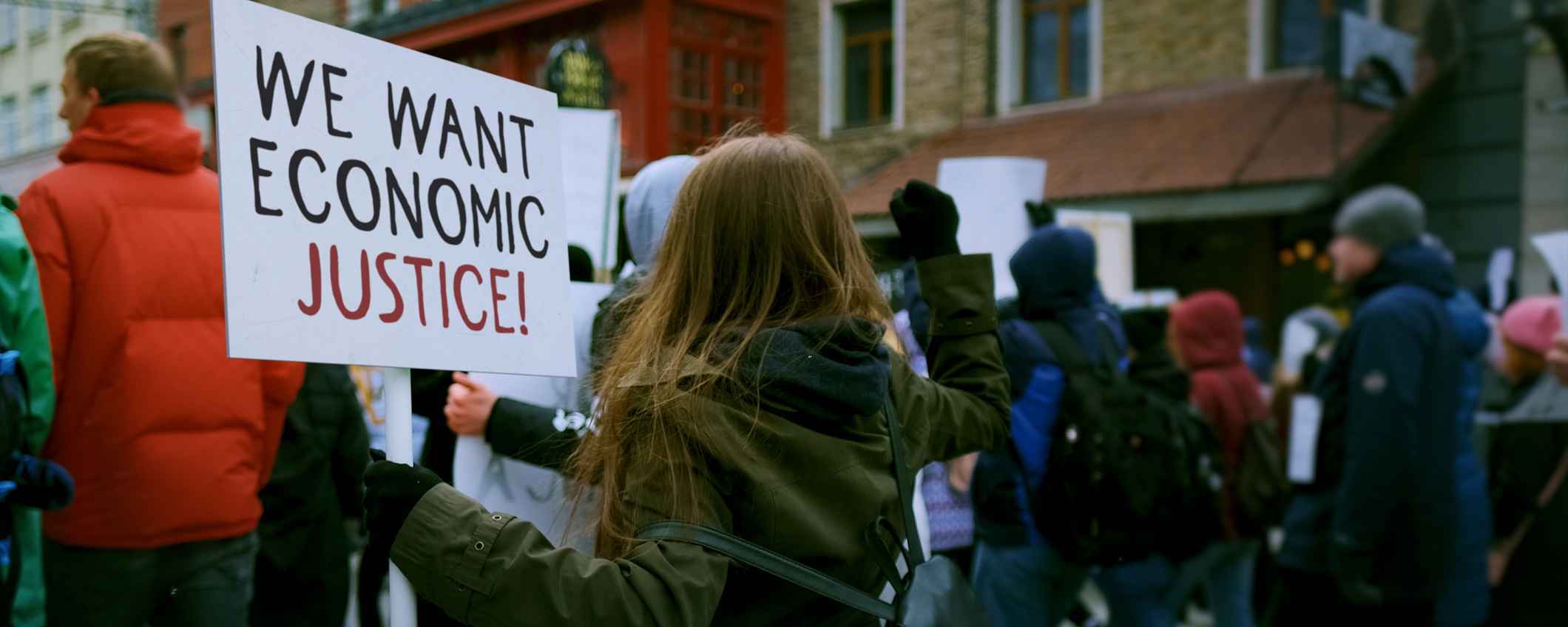
For any organisation that claims to be values-aligned, fair tax isn't optional. Tax is a contribution to a better, fairer society that should be shared by everyone and every industry.
The Fair Tax mark is an independent certification that verifies a business pays the right amount of tax - and unfortunately, barely any banks have it.
We need to talk about tax
A lot has been happening with tax lately. In June, the world saw its first trillionaire. Across Europe, economists have started debating wealth taxes with more intensity than before. In the UK, public services are stretched thin, and the OECD estimates that between $100 and $240 billion in corporate tax revenue is lost every year to companies moving profits out of the countries where they operate. Independent researchers think the real figure is much higher.
There's a lot of noise in all of this, and it's easy to feel like there's nothing you can do about it. Tax policy is set by governments, corporate strategy is set by boards, your salary likely gets taxed at source.
But there's one place a personal choice does connect directly to the tax conversation, and it's your bank. Because banks are some of the biggest multinational corporations in the world, with complex tax positions of their own, and they lend huge amounts to the industries who could be involved in tax avoidance practises.
The Fair Tax Mark
The Fair Tax Mark is the global gold standard for responsible corporate tax conduct. It's run by the Fair Tax Foundation, an independent non-profit set up in 2014.
To be awarded the Mark, a business must show it pays the right amount of tax, in the right place, and at the right time. It has to publish country-by-country reporting, which means showing publicly, in every country it operates in, how much profit it made and how much tax it paid, and it has to actively refuse to use tax havens or other avoidance structures.
The accreditation is audited every year. Businesses must keep meeting the standard to keep the Mark. It isn't a badge companies can pay for - it's a rigorous process that makes the ins and outs of how a business behaves visible.
Around 275 businesses globally have the Fair Tax Mark. Some are names you'll recognise, such as The Co-op Group, Lush, Richer Sounds, Timpson, and SSE. Together they employ more than 475,000 people and contribute over £4 billion in corporate income tax every year.
But if you look at that list closely, one sector is largely absent.
Only a small number of banks are on the list
Of the 275 accredited businesses, only a handful are financial institutions. In the UK, the three that hold the Mark are Unity Trust Bank, a specialist bank serving the social economy and the first bank in the world to be awarded the Fair Tax Mark, along with Leeds Building Society and Ecology Building Society.
This year, Triodos became the first international bank in the world to earn the Fair Tax Mark.
That's a striking gap because banking is a huge industry. It decides where the world's money flows, which businesses grow, and which industries stay funded. But of every international bank operating today, uptake of independent tax accreditation has been slow to almost non-existent.
A certification that's been available to any business for over a decade has been embraced by retailers, cooperatives, building societies, and small independents. Among international banks, almost no one has committed to it.
There is a fair question to ask about why and there's a more useful question every banking customer can ask themselves: If my bank hasn't sought independent verification of its tax practices, what does that tell me?
What this means for the money in your account
If your bank hasn't committed to responsible tax conduct, either for itself or for the businesses it lends to, some of your money may be supporting practices that reduce corporate contribution to public finances. That might mean less funding for the NHS, less for the school your children go to, less for the roads you drive on, and less for the climate transition we all depend on. The money still needs to come from somewhere, and it usually comes from cuts, or from higher taxes on the people least able to afford them.
Your bank isn't required to tell you any of this, so unfortunately most don't. That's exactly why an independent certification like the Fair Tax Mark matters. Rather than trusting the language on the front page of a bank's website, you can see whether it has done the work.
How Triodos is different
While earning the Fair Tax Mark this year was a proud moment for us at Triodos, it wasn't the start of something new for us. It's the confirmation of an approach that's been in place for years.
Every year, Triodos publishes country-by-country reporting on profits and taxes as part of our Group Annual Report. When we lend to a business, the borrower's tax conduct is part of our due diligence. Companies engaged in tax avoidance, or in arrangements that raise serious ethical or legal concerns, are excluded from our lending. It's the same logic we apply to the fossil fuel industry, weapons, and other harmful sectors. The standards we apply to where money flows are what shape what gets built.
That means when you save with Triodos, your money goes to organisations working on renewable energy, affordable housing, nature recovery, social care, and sustainable food.
Our UK Head of Tax, Gillian Cox, recently reflected on what this looks like inside the bank in a recent interview with the Fair Tax Foundation. In her words: "The Bank's Group-wide mission is to make money work for positive change. Helping to create a society that protects and promotes quality of life and has human dignity at its core. The Bank's approach to tax is no different. It must be conducted in a way that supports the mission."
Thanks for joining the conversation.
We've sent you an email - click on the link to publish your post.